
Teodosio welds metal into shapes that read as abstract clutter until a single lamp turns them into pictures. His work now hangs from Baden-Baden to Los Angeles.
ATHENS — The object on the plinth looks like a tangle of welded metal, or a bundle of branches, or several hundred small steel balls strung together without obvious order. Then a single lamp comes on, and the wall behind it shows a woman holding leaves, or a flamenco dancer mid-turn, or Picasso's Guernica.
This is the whole of Teodosio's practice, and he has spent more than a decade refining it. The Athens-based sculptor builds three-dimensional compositions in stainless steel, bronze, branches and found objects, calculated so that one light source throws a precise figurative image. The sculpture and the shadow are not the same artwork. That is the point.
“I create one sculpture, but tell two completely different stories,” he said.
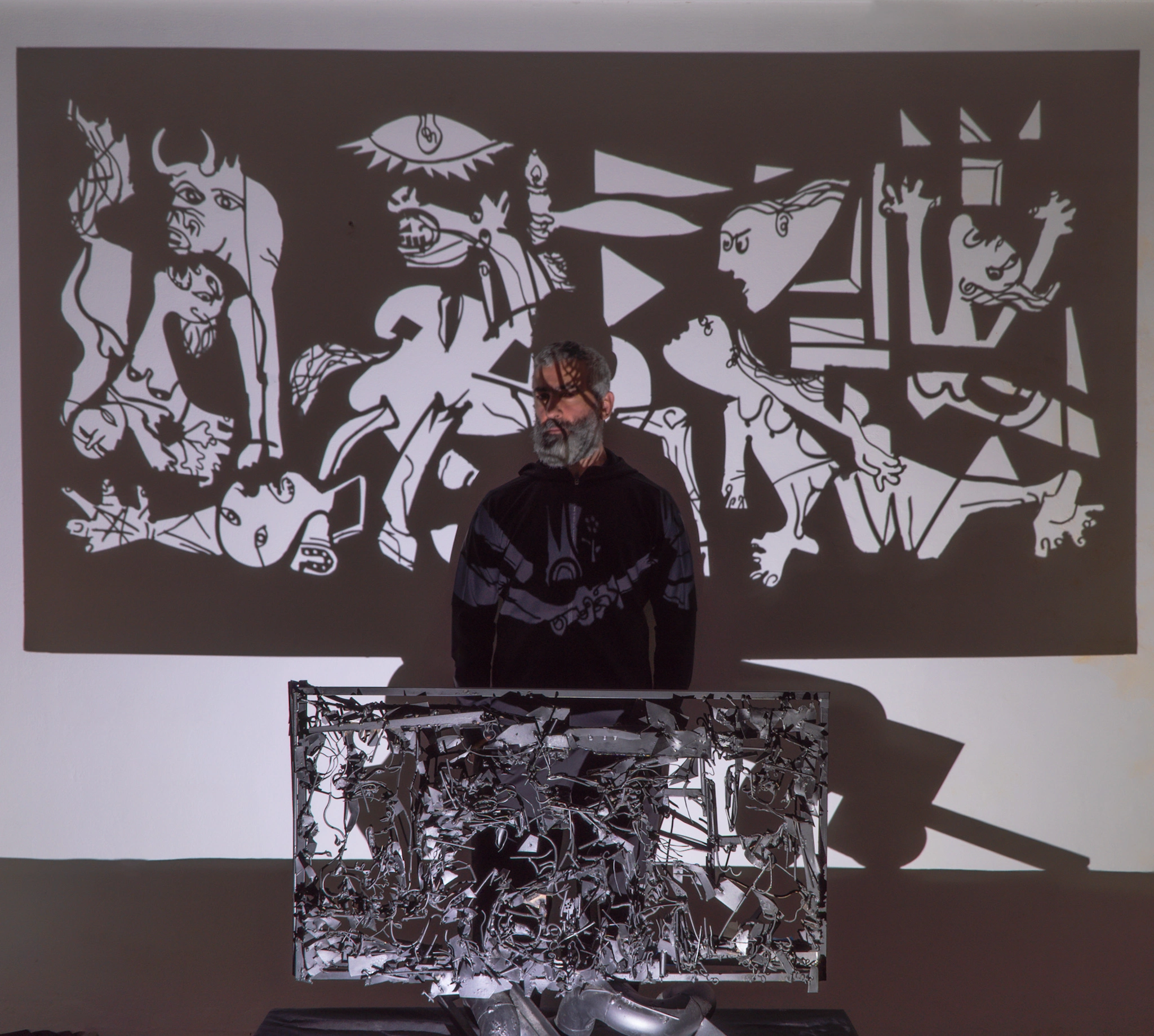
International attention came early. My Modern Met featured him in January 2014, and VICE followed in November 2015, drawn to an iron construction whose shadow resolved into Guernica and another, built from 350 interconnected metallic balls arranged on the logic of a DNA helix, that cast Leonardo's Vitruvian Man. He also made a version of Michelangelo's The Creation of Adam. He was then working under the name Teodosio Sectio Aurea, after the golden ratio.
The exhibition record since has been steady rather than showy. He showed at the Affordable Art Fair in Seattle in 2012, held solo exhibitions at the Cultural Conference Center of Heraklion in Crete in 2015 and at the Onassis Cardiac Surgery Center in Athens in 2017, took part in the RE:SOURCE ecological art exhibition in 2023, and appeared at the fifth EuropArtFair in Amsterdam in 2024. The same year he built a shadow work called “Outside the Box” for FedEx. His pieces are held in the Paradox Illusion Museum in New York and in private collections across Europe and the United States, and he has been interviewed on Deutsche Welle television.
His largest single installation is a private commission for the Steigenberger Icon Europäischer Hof, a luxury hotel in Baden-Baden, Germany, where 24 of his sculptures run through the corridors. More recently he made a piece for the Spanish flamenco choreographer María Pagés that appears to be a white marble tree and throws the shadow of a dancer. Through 2026 he has travelled to install commissions personally in Los Angeles, London and Germany, adjusting each composition to the light in the room it will live in.
He returns often to a saying about perception.
“One person looks into a puddle and sees mud, while another sees the stars reflected in it,” he said. “Sometimes, what appears to be chaos hides extraordinary harmony.”
The work he took to the London Art Biennale in 2025 makes that thought literal. Ourania, a 90-centimetre square piece assembled from intertwined branches and natural materials, is named for the ancient Greek muse of astronomy. Unlit, it is a thicket. The muse appears only in the shadow.
A shadow is usually treated as a by-product, evidence that something solid got in the way of a lamp. Teodosio has built a career on the opposite premise.
“For me, a shadow is not the absence of light,” he said, “but another dimension of art.”